
INSIDE LOOK: Something surprised me about covering the World Cup
Behind the scenes of my Ivory Coast vs. Ecuador assignment

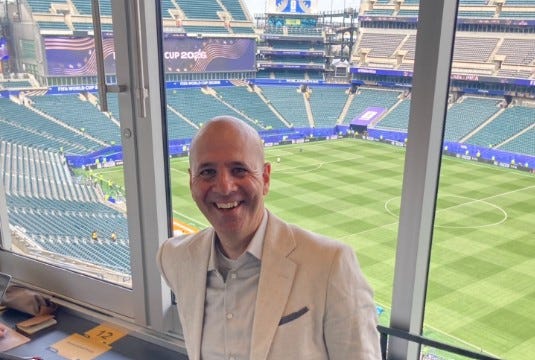
A pregame photo of me in the Linc press box prior to the World Cup match between Ivory Coast and Ecuador on June 14, 2026.
By AARON BRACY
June 17, 2026
Bracy Sports Media Newsletter
My first paid sportswriting assignment came in 1997 via the Associated Press. Nearly 30 years later, I am still plugging away. Sportswriting is a side hustle for me these days, and it is something that I still truly love.
Whether for the AP, Big5Hoops, or someone else, or doing legwork for my books, I still look forward to every opportunity to enter a press box, continuing to live out a dream that I imagined while reading Bill Lyon’s columns in the Philadelphia Inquirer with my morning cereal as a teenager. That said, I have covered so many games over the last three decades that they sometimes blend together.
My routine for each assignment is similar: research in advance, catch up on anything new upon arrival, pay attention to the game in front of me and commentary on social media, blend everything into a deadline story, get quotes, update the story, and maybe put out a video or two on social media. Rinse and repeat. I have done this well into the thousands of times.
When the opportunity to cover the World Cup in Philadelphia was presented to me last fall, I looked forward to it in much the same way I do any other assignment. Midweek last week, the AP informed me that I would be writing the main story for the Ivory Coast vs. Ecuador match this past Sunday night at the Linc. Not long after, I started feeling a heightened level of excitement from what I am accustomed. That excitement just grew and grew as the match got closer.
I recall feeling similarly about covering the World Series in 2022 when the Phillies played the Astros. After covering so many Phillies games, probably close to a thousand of them, I was surprised then by how excited I felt for the Fall Classic. Likewise, I was surprised by how excited I was for the World Cup. And, just like the World Series, I am glad and grateful that I got the opportunity to cover it.
--
Click HERE to read my final story from Ivory Coast vs. Ecuador for the AP. Feel free to read now, or save it until the end of this newsletter.
--
Below is a behind-the-scenes look at how I covered the match.
Research
This is a vital part of any of my assignments. For my books, the research took the most time. When I cover a typical Phillies game, like Monday night against the Marlins for the AP, I might do 30 minutes to an hour of research. I like to write everything out on paper.
For the Ivory Coast vs. Ecuador match, I spent several hours in preparation over several nights last week. Besides getting to know both teams, I needed to understand this match in the larger picture of the World Cup. In addition to my hand-written notes, I started a Google doc with notes, something that I did for both books but is rare for most assignments. Specifically, I copied the name of each player into the Google doc, being sure to correctly capture accent marks that would be hard to find on the keyboard. I then looked up each player individually and took a few notes.
Both the background research on the teams and the individual players proved hugely helpful during the match.
Here you can see my hand-written notes and jottings about the players on the roster. (Note: My Google doc had all of the accent marks; this printout does not.)
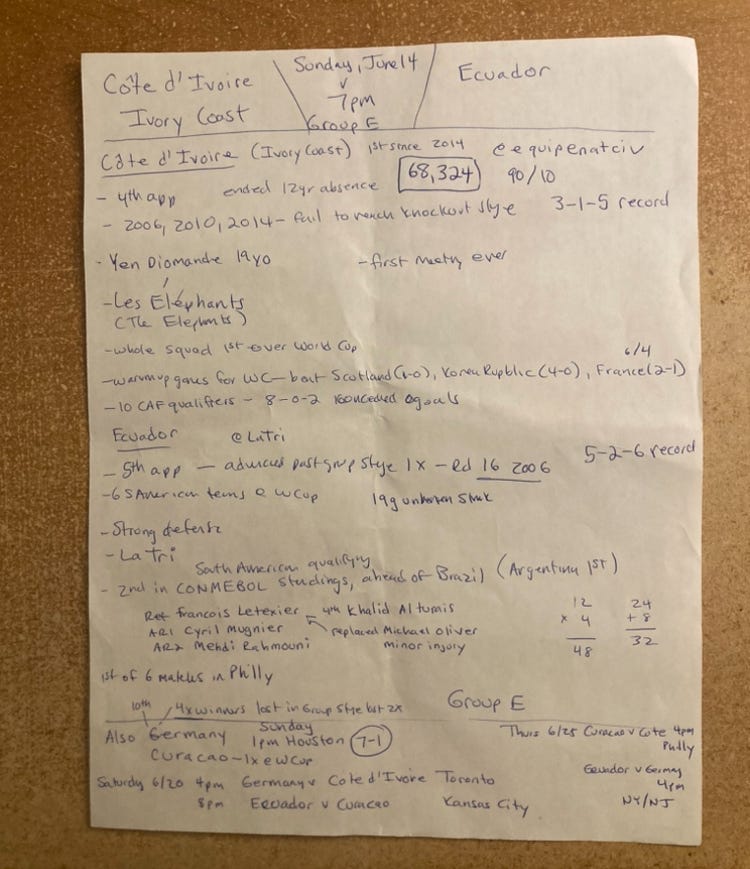
My pregame notes for Ivory Coast vs. Ecuador in the World Cup on June 14, 2026.
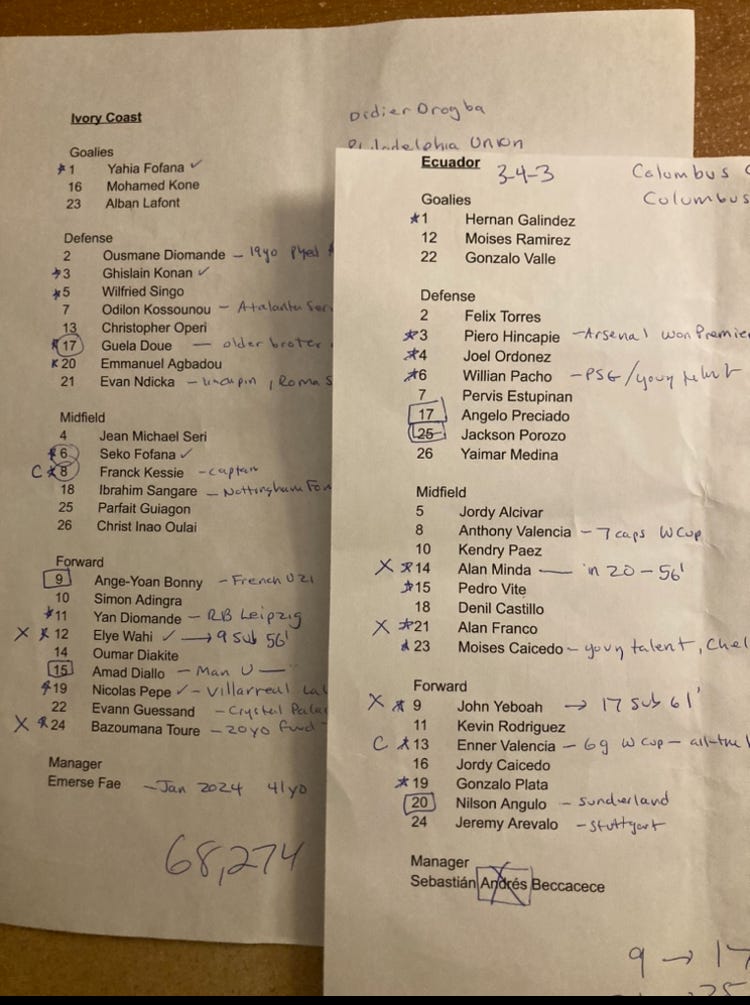
My roster notes for Ivory Coast vs. Ecuador in the World Cup on June 14, 2026.
In-game Coverage
During the match, as per usual, I wrote down observations in my reporter’s notebook. I prefer taking notes by hand. For example, whenever I cover a Phillies game, I write down every scoring play in my notebook for reference later. It is an old-school approach, I know, but it works for me.
For the Ivory Coast vs. Ecuador match, I had five pages of notes. This page was particularly important because it featured two shots that hit the crossbar and three yellow cards. One thing you might notice below is that these notes might look sloppy and unreadable, but they mean something to me.
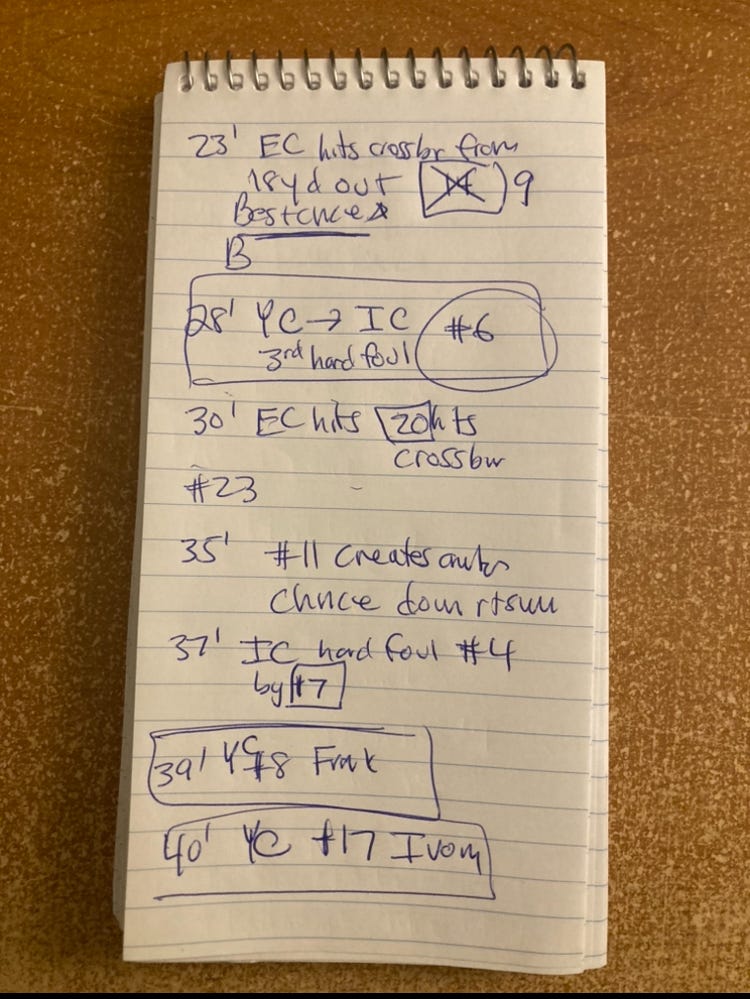
My in-game notes for Ivory Coast vs. Ecuador in the World Cup on June 14, 2026.
Deadline Story
My assignment for the AP was to write a 300-word story at the final whistle and then come back with a write-thru of 500 or so words as soon as possible. The write-thru would include quotes from the participants and would have a little more feature-like of a lede and any necessary added details.
Although I have a lot of experience and have done this probably more than a thousand times, I would not consider writing a story that needs to be filed as soon as the game ends easy. Some sports, like baseball and football, tend to be easier. Basketball, with games often not decided until the final seconds, tends to be the most challenging. At least for me. The biggest challenge always is if the game is undecided entering the waning moments.
The challenge facing me with the Ivory Coast vs. Ecuador match was that the game was scoreless deep into the second half. As many (every?) sportswriter will tell you, we do not root for the teams; we root for ourselves. I was rooting for a goal early in the second half so I could craft a story. That goal did not come, unfortunately.
Meantime, I had not written a single word with the game about to enter the 70th minute. This is something I learned early in my career, to be patient. I vividly recall Chris Sheridan, the former AP national NBA writer, lifting his screen at a 76ers game and showing me what he had done so far as the contest entered the late stages. It was a blank screen. A good lesson for a young sportswriter.
In this case, I knew I could not wait much longer if I was going to get that story to the AP at the final whistle, so in the 70th minute I started writing a story as if Ivory Coast and Ecuador ended in a scoreless draw. I was very pleased with the finished story as the match was just about to enter stoppage time when I had to quickly change course.
Amad Diallo, Ivory Coast’s talented striker, scored a beautiful goal in the 90th minute. Well, scrap the scoreless draw story. There were seven minutes of stoppage time. No timeouts or commercials in soccer. I had less than 10 minutes to rewrite the story. This was not new ground, but it was still a challenge. This is where all of the research paid off. I quickly consulted my hand-written notes, both in my notebook and copy paper, and used them to help craft a story that highlighted what happened in the match while also acknowledging the bigger picture of what the victory means for Ivory Coast and what the defeat means for Ecuador.
Postgame
As I always do, I went into the press conference prepared with questions that would help my story. For Ivory Coast, I wanted to learn more about the goal and also wanted to ask about the impact of the side’s physical style of play. There was also the wonderful play of Ivory Coast’s Yan Diomande that interested me. For Ecuador, I wanted to ask about the effect of two scoring attempts hitting off the crossbar. I also wondered about the reaction to the obvious disappointment of the loss, particularly in front of a partisan Ecuador crowd.
I did ask questions to both managers. In a first for me, I used the FIFA translation app, which allowed me to listen to the coaches’ French and Spanish answers in English and allowed them to hear my English questions in their native language. This was really cool! The only downside was that I could not record their answers while listening on my headphones. (Maybe I could but, try as I might, sometimes technology eludes me.) The good news is, I have developed a short-hand for recording answers in my notebook. There is no science to it, and I can’t really explain it, other than to say I seriously abbreviate a lot of words. It might look like gibberish. Most importantly, I understand it.
Here are a couple of pages from the Ecuador manager. You might even be able to make out some of this. LOL!
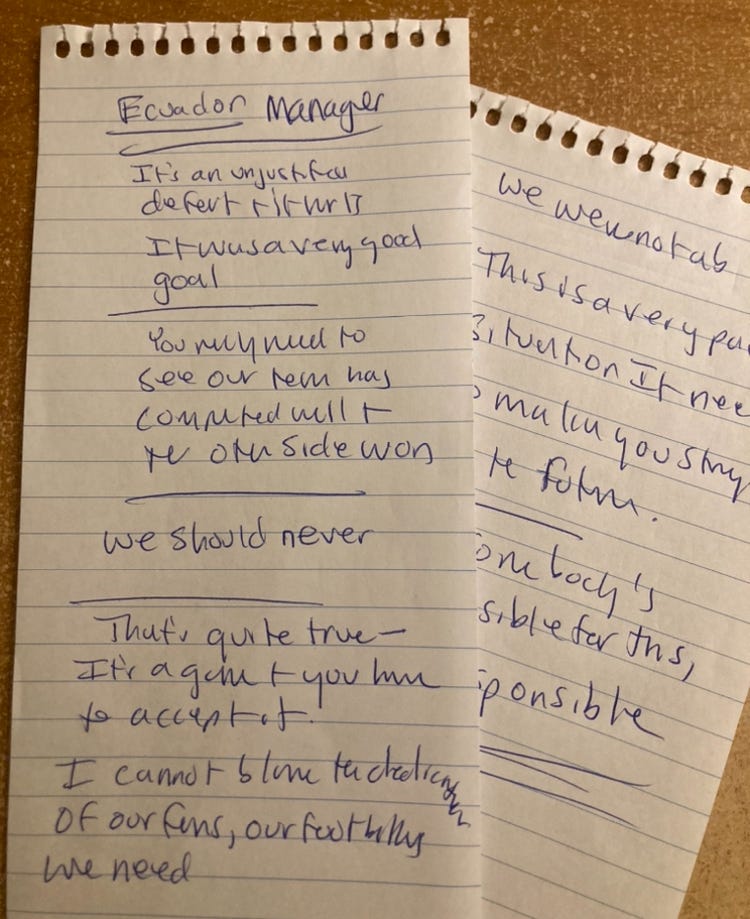
Some hand-written postgame quotes in my notebook from Ecuador manager Sebastián Beccacece.
Write-thru Story
The final step on this night was to take the quotes and update the story I filed at the final whistle. I asked the questions that I hoped would work in the story, and the managers’ answers really fit like a glove. I got the idea for the reworked lede from something Ivory Coast manager Emerse Faé said during his postgame remarks.
It did take a while for the press conferences to begin, so I did not get back to the press box until more than an hour after the final whistle. Generally, the AP is looking for a write-thru no more than an hour after the buzzer. In this case, I could not control how long the press conferences took. I quickly typed the quotes into my story, reworked the lede, and filed. It took no more than 10 minutes.
I sent a confirmation message in Slack, took a deep, relaxing breath, and smiled at what had been a wonderfully exciting experience.
--
Aaron Bracy has covered sports in Philadelphia for nearly three decades for various publications and as a freelancer for the Associated Press. His first book, A Soaring Season: The Incredible, Inspiring Story of the 2003–04 Saint Joseph’s Hawks (Brookline), can be ordered HERE. His second book, Are You Kidding Me? The Incredible, Inspiring Story of Allen Iverson and the 2001 Philadelphia 76ers (Brookline) is scheduled to be published in February 2027. You can preorder it HERE. Follow Bracy on social media HERE. Contact him at bracymedia@gmail.com.
Awesome look at the chaos of live reporting a sporting event. Excellent stuff Aaron!